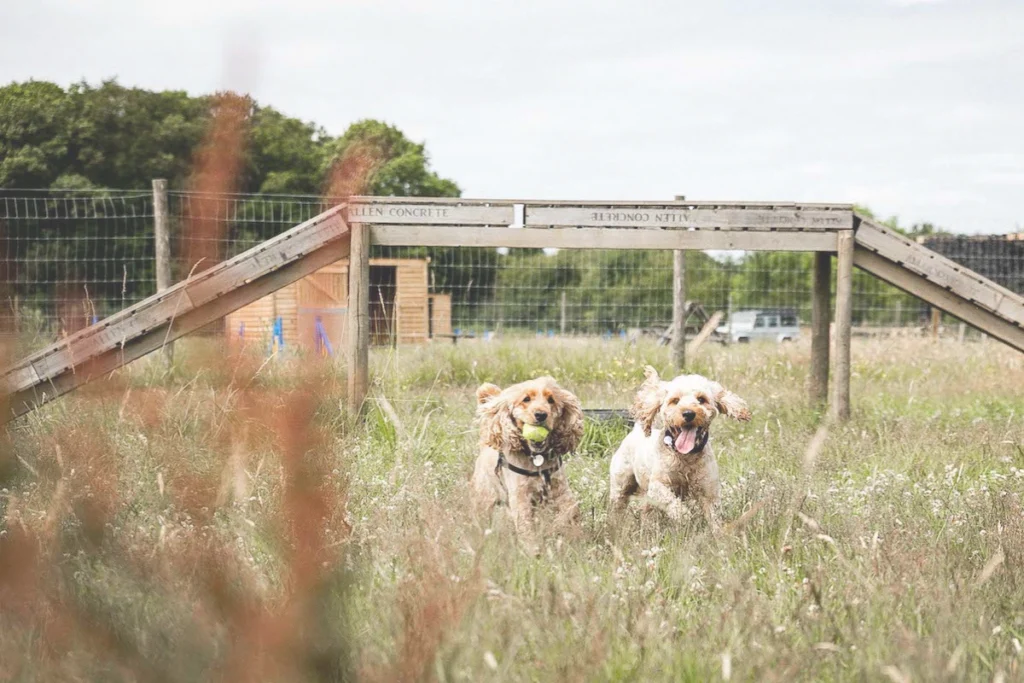
There’s a quiet shift happening in how serious pet owners, premium service providers, and even investors in the pet economy view puppy care. Subscribing to a dedicated day care professional helps move the owner’s role from a passive monitor (supervision) to a strategic architect of the dog’s biological and behavioral future (stewardship). The first six months have become a strategic window where expertise, environment, and intent shape outcomes for years to come. This is where professional-grade puppy development separates convenience care from genuinely transformative care.
Content
1. Neuro-Sensory Integration and Proprioceptive Puppy Confidence
What’s really being built: a puppy that understands its body and surroundings, not one that merely reacts. High-end puppy care now treats early sensory exposure like infrastructure planning. Random play in a city—loud noises, unpredictable large dogs, and uniform concrete—often leads to “Sensory Flooding.
However, in a professional puppy day care, rather than random play, puppies are guided through controlled, biologically rich environments that challenge balance, texture recognition, and sensory processing—without overwhelming the nervous system.
Where expertise shows up:
Sequenced exposure to natural surfaces that activate neural pathways
Brief stimulus encounters followed by intentional pauses, allowing processing rather than overload
Core-stability work that quietly prevents future coordination and confidence issues
This level of care solves a specific, modern problem: dogs raised in visually loud but physically monotonous urban spaces. Well-designed puppy rearing strategies asserts a dog’s ability to remain calm even in a chaotic environment.
What’s really being protected: long-term mobility, resilience, and medical cost exposure.
Professional puppy services increasingly operate like early-warning systems. Subtle changes in movement, energy, or play patterns are tracked not to alarm—but to inform. The value here isn’t the technology itself; it’s interpretation.
Strategic advantages include:
Establishing a personal activity baseline for each puppy
Detecting asymmetry or fatigue patterns before injury becomes visible
Pairing biometric data with visual observation for contextual accuracy
This approach replaces the old “wait and see” mindset with proactive stewardship. For owners, it’s peace of mind. For businesses, it’s risk mitigation. For puppies, it’s the difference between a strong foundation and a silent flaw that surfaces years later.
3. Cognitive Foraging and Emotional Down-Regulation
This is about a pet’s training on impulse control, focus, and the ability to self-settle. Modern puppy care recognizes that constant stimulation creates fragile dogs. The new standard is intentional contrast—high engagement followed by structured calm. Feeding, resting, and problem-solving are treated as cognitive work, not downtime.
Professionally guided environments focus on:
Replacing passive feeding with puzzle-based, effort-driven intake
Using licking and scent work to biologically lower stress hormones
Teaching puppies that calm behavior is rewarding, not boring
This strategy directly addresses destructive behavior and anxiety—not through correction, but through neurochemistry. It’s a sustainable solution that reflects both behavioral science and emotional intelligence.
4. Curated Socialization & Pack Literacy
Expert guided pet socialization enhances social fluency, not dominance or submission. Elite puppy socialization looks less like chaos and more like diplomacy. It is the rejection of the traditional dog park—which is often a high-risk “free-for-all”—in favor of a clinical social environment where every interaction is engineered for success. Experts curate puppy groupings that align with a complex mix of size, temperament, and energy thresholds.
Best-in-class practices include:
Small, consistent social groups to build trust and predictability
Short interaction cycles to prevent over-arousal
Calm transitions between play, movement, and rest
Such level of curation prevents future reactivity and teaches puppies how to coexist without constant escalation. It’s particularly critical for smaller breeds, whose needs are often misunderstood in generic settings.
In essence, embracing professional puppy care helps transition from managing a pet to optimizing the holistic well-being this biological asset. When you move from passive pet supervision to professional stewardship, you are essentially building a proprietary operating system for your dog. The leverages for these outcomes aren’t found in more toys or longer walks, but in the precision of the environment and the intent of the interaction.